Famous Blog Posts

Famous Blog Posts Collection Among Best Websites in Techno Entrepreneurships

Wednesday, 22 April 2015

Top Universities in the World 2015 on Information Technology


Today marks the release of 10th edition of the QS World University Rankings®, which uses six performance indicators to assess and compare the top universities in the world each year. Throughout the decade in which QS has been publishing the rankings, the very top the table has remained fairly stable, with just some minor shifts in position each year. 
Top Universities in the World 2014/15 main image
Indeed, the differences between these top-ranking institutions are incredibly small; all perform impressively well across all of the assessment measures used. (To see how the top universities in the world compare on each performance indicator, visit the interactive ranking table.)

Top 10 Universities in the World 

Country
Position in 2014/15
Position in 2013/14
Massachusetts Institute of Technology (MIT)
US
1
1
University of Cambridge
UK
2=
3
Imperial College London
UK
2=
5
Harvard University
US
4
2
UCL (University College London)
UK
5=
4
University of Oxford
UK
5=
6
Stanford University
US
7
7
California Institute of Technology (Caltech)
US
8
10
Princeton University
US
9
10
Yale University
US
10
8


The global spread of top universities

As this table illustrates, the top of the ranking is dominated by universities in the US and UK, which each claim half of the top 10 places. A further five US universities and two more UK entrants appear within the top 20, but beyond this the list does become much more internationally diverse. US universities account for 28 of the top 100 places, and UK universities 19 – so in fact more than half of the top universities in the world are located outside of these two nations.

Switzerland’s ETH Zurich, retaining 12th position, is the highest-ranked institution from elsewhere, followed by its country-mate Ecole Polytechnique Fédérale de Lausanne (EPFL) at 17=. Canada’sUniversity of Toronto and McGill University place 20th and 21st respectively, with the National University of Singapore (NUS) following directly behind in 22nd. Also ranked within the global top 30 are France’s Ecole Normale Supérieure, Paris (24th), Australian National University (25=) and the University of Hong Kong (28th).

South Korea, Japan, Denmark, China, Germany and the Netherlands all also have at least one representative among the top 50 universities in the world this year, while the top 100 also features universities in Sweden, Finland, Ireland, Taiwan, Belgium and New Zealand. The global top 200 universities are spread across a total of 31 countries.
Success of STEM-focused universities

Another trend reflected at the top of the table is the growing success enjoyed by universities with a focus on the STEM (science, technology, engineering and mathematics) spectrum of subjects. This is exemplified by table-topper Massachusetts Institute of Technology (MIT) and its fellow US STEM specialist California Institute of Technology (Caltech), which has gained two places this year.


Meanwhile the UK’s Imperial College London, another STEM-focused institution, boasts the biggest leap within the top 10 universities this year, rising from 5th to share second place with theUniversity of Cambridge.

The rankings also suggest a wider-reaching pattern of success for STEM specialists. ETH Zurich and EPFL Lausanne both fall into this category, meaning that STEM-focused universities account for a quarter of the top 20 places. Other science and technology-oriented institutions which have gained ground in this year’s ranking include France’s Ecole Polytechnique ParisTech (climbing six places to 35th), Singapore’s Nanyang Technological University (up two places to 39th), and South Korea’sKAIST (rising nine places to reach 51st).

As Danny Byrne writes in this year’s supplement to the rankings, it seems universities focusing on science and technology subjects have been particularly successful at meeting the challenge of balancing “research excellence with small sizes and comprehensive internationalization”.

Best Colleges list 2015: Top 50 National Universities in US

​This year marks the 30th edition of the ​U.S. News Best Collegesrankings, which includes top National Universities​. These research institutions award degrees at every level, from bachelor's degrees to doctorates.


The top 50​ schools span both coasts and include both large and small universities. Check out the following photos to see the National Universities that topped the rankings for 2015. ​

What are the best colleges and universities in America considered geographically by state? In this ranking we present the best four-year liberal arts college and the best full-fledged university in each of the 50 states.

Most rankings of colleges and universities are top-heavy with schools from the East Coast (the Ivy League, MIT, etc.), California (Stanford, Cal Berkeley, etc.), and a few schools scattered throughout the rest of the country (University of Chicago, Vanderbilt, etc.).

In this ranking, we make geographical diversity our main focus, looking for the best education offered in each state, from Alabama to Wyoming.

Our criteria for putting a school on this list include the reputation of the school and its faculty, its dedication to a broad liberal arts education, its accreditation, and its overall academic caliber compared to other institutions of the same type within the same state.


Some states have an embarrassment of riches when it comes to institutions of higher learning (such as Massachusetts and California). In those cases, our job was not easy. Where two institutions were dominant—one primarily oriented towards the liberal arts and the other towards science and engineering—we went with the liberal arts school as offering a broader range of excellence across the curriculum (hence Harvard over MIT).

The result is a unique list of schools, two from each state, one a full-fledged research university, the other a college focused on undergraduate education. We believe this list identifies the very best that higher education has to offer across the length and breadth of this great land.

Note: For each state, we list the university first, and the liberal arts college second, regardless of alphabetical order. Also bear in mind that names can be misleading: Several of the institutions on our list that are essentially 4-year liberal arts colleges use the word “university” in their name. By the same token, one of our nation’s top research universities calls itself a “college” (see if you can spot it).
ALABAMA

Auburn University (Auburn, AL)

Established in 1856, Auburn University went through four names changes before settling on its current and longest-lasting title.

This public university sits on a sprawling 1,800-acre campus, complete with abundant student housing, dining, health services, counseling, and recreational facilities, among other amenities such as the 300 student-led organizations that meet on campus. Jordan-Hare Stadium, where the Auburn Tigers and mascot Aubie dominate the football field, is also located on campus.

While the school was originally focused on mainly agriculture and the arts, it now offers over 140 majors for students to choose from, 38 in the College of Liberal Arts alone. The university boasts a thriving student body of over 25,000 students and 1,200 faculty members. These numbers make it one of the largest universities in the state of Alabama.

Accredited by the Southern Association of Colleges and Schools, auburn is considered one of the best, yet least-expensive, universities in the southeastern United States.

Spring Hill College (Mobile, AL)


Spring Hill College is one of the oldest Roman Catholic universities in the southeastern U.S. Founded by the Jesuit order and located in Mobile, Alabama, this small liberal arts college was established in 1830, making it the fifth-oldest Catholic college in the country.

Spring Hill College currently offers 49 majors spread out over several Schools. These Schools include Business, Communication Arts, English, Fine and Performing Arts, Foreign Languages, Interdivisional Studies, Nursing, Philosophy and Theology, Sciences, Social Sciences, and Teacher Education.

Situated on 400 acres in Mobile’s scenic Spring Hill neighborhood, the college has enough housing for all undergraduates to have a guaranteed room on campus for the entirety of their undergraduate career. The school currently employs 72 faculty members, who teach a student body comprising approximately 1,300 students. The college takes pride in its small class sizes—which average 16 students per class—and its 12-to-one student-to-faculty ratio.

While the student body may be small, they are spirited and active in clubs and activities of all kinds. There are more than 50 affiliated student-led organizations, including but not limited to fraternities, sororities, academic clubs, ministries, and athletic clubs.

Like Auburn University, Spring Hill College is also accredited by the Southern Association of Colleges and Schools.

Jesuit program brings university education to refugees


Back to list of states

* * *
ALASKA

University of Alaska Anchorage (Anchorage, AK)

The University of Alaska Anchorage (UAA) is Alaska’s largest higher education institution and is appropriately located in the state’s largest city, Anchorage.

UAA opened in 1954 as a community college, and began offering some upper-division courses in 1969. In 1976, UAA made the leap to a full-fledged university, offering the complete gamut of lower and upper division courses.

Despite its humble beginnings, UAA is now home to over 17,000 students, who are divided among UAA’s six teaching units or colleges. These colleges include Education, Health and Social Welfare, Arts and Sciences, Business and Public Policy, Engineering and the Community, and a technical college.

The campus itself is situated among some of Alaska’s most beautiful backdrops, surrounded by lakes and integrated into an intricate city-wide system of trails while still remaining a part of the local urban landscape.

The University of Alaska at Anchorage is accredited by the Northwest Commission on Colleges and Universities.

Alaska Pacific University (Anchorage, AK)

Established in 1960, just one year after Alaska officially joined the United States, Alaska Pacific University (APU) is a liberal arts school specializing in four-year degrees.

Located in the Churagh Mountains 45 miles east of downtown Anchorage, APU’s 170-acre campus is home to 750 students. The school boasts several different unconventional study programs, which allow students more freedom to choose how to approach their education.

APU focuses on small class sizes and an active, kinetic learning environment. This learning method teaches the skills needed to succeed both in the workplace and in life. The academic programs include the Schools of Education, Environment Science, Liberal Studies, Outdoor Studies, Psychology, and Human Services.

APU’s School of Liberal Studies offers concentrations in literature, philosophy, pre-law, pre-med, religious studies, and writing. The campus also contains the impressive state-of-the-art Mosley Sports Center, which is home to the world-renowned Nordic Ski Club.

Alaska Pacific University is accredited by the Northwest Commission on Colleges and Universities.

Back to list of states

* * *
ARIZONA

University of Arizona (Tucson, AZ)

The University of Arizona (UA), which first opened its doors in 1885 (30 years before Arizona was even recognized as a state!), has evolved over the years into a first-class—indeed world-renowned—public research university.

The founders bravely decided to break ground on the 380-acre campus in what was essentially the middle of the desert. Today, the UA campus is a part of a flourishing urban city-center. The university now boasts a student body approaching 40,000 students and employs a faculty of 2,500 people.

UA currently offers 334 fields of study organized into 17 different colleges, including the Colleges of Agriculture and Life Sciences, Architecture, Planning and Landscape, Education, Engineering, Fine Arts, Humanities, Medicine, Nursing, Optical Sciences, Pharmacy, Science, Social and Behavioral Studies, Letters, Art, and Sciences, Public Health,Law, and Management. The university also has an additional college of medicine, which is located at their Phoenix campus.

Campus life at UA is bursting with possibilities. With a breathtaking 718 active recognized clubs, from sports to the most arcane academic subjects, making friends with other students who share your interests is easy. In fact, the campus is practically a city in and of itself.

The University of Arizona is accredited by the Higher Learning Commission’s North Central Association.

Prescott College (Prescott, AZ)

Founded in 1966, Prescott College is a liberal arts college located in Prescott, between Phoenix and Flagstaff. The 200-acre campus is perched in Arizona’s central highlands surrounded by a variety of landscapes, including striking mountain ranges, flat desert plains, and abundant forests.

Prescott College is a non-profit organization with a mission statement encompassing liberal arts, the environment, and social justice. They strive to provide programs that are integral to the community of Prescott and allow students to act as participants in the city surrounding their college, while serving the ever-expanding global community. The school’s current student body is approximate;y 1,200 students, which translates into an impressive seven-to-one student-to-faculty ratio—a number that really sets Prescott College apart, even from most other small liberal arts colleges.

The college currently offers programs in arts, creative writing, environmental studies, and interdisciplinary arts and letters. First-year students are given the opportunity to live in the Village, a new sustainable, LEED (Leadership in Energy & Environmental Design) platinum-certified complex. Upper classmen live with other students in off-campus housing.

Prescott College is accredited by the North Central Association of the Higher Learning Commission. Additionally, all the programs offered are accredited by the Association for Experiential Education.

Back to list of states

* * *
ARKANSAS

University of Arkansas (Fayetteville, AR)

The University of Arkansas opened its doors in 1871, just years after the American Civil War left the South devastated, making it the first public university in the state. The 412-acre campus, located in the city of Fayetteville, is perched on a hill overlooking the iconic Ozark Mountains.

The university offers degrees in 214 areas of study and is considered one of the 50 best public universities in the US. The Fullbright College of Arts and Letters encompasses 19 different departments and upwards of 30 programs. It is the most diverse in its offerings of all the Colleges that comprise the university.

The University of Arkansas’s current enrollment is approximately 25,000 students, with a student-to-faculty ratio of 19-to-one, an impressive feat for a university of this size! Campus life is lively. Greek life is in full swing among the 41 fraternities and sororities.

The school’s athletic teams, the Razorbacks—often affectionately referred to as the Hogs—are major competitors in the college football and basketball scene on a regular basis. In fact, no other school in the Southeastern Conference of the NCCA has won more championships. The marching band is known for their intricate half-time routines.

The University of Arkansas is accredited by the Higher Learning Commission of the North Central Association of Colleges and Schools.

Hendrix College (Conway, AR)

Hendrix College is a private liberal art college that is affiliated with the United Methodist Church, but teaches a secular curriculum. The four-year private college, which opened in 1876, is located in Conway, just 30 minutes from the state capital of Little Rock.

The current student body consists of 1,432 students and employs a faculty of 126 academic staff members. Despite the small size of the student body, diversity is an integral part of the campus dynamic. Students hail from 43 of the 50 states and represent 14 foreign counties.

The average class is comprised of only 17 students. Considered one of the best liberal art colleges in the country, admission is competitive. Incoming freshmen frequently have a grade point average (GPA) exceeding 4.0!

Hendrix College hosts a variety of sports teams, including uncommon options such as field hockey and lacrosse, but if you are looking to join a fraternity, this is not the college for you. The school has no established fraternities or sororities. Despite the lack of a Greek system, campus social life is robust—the school has 65 active clubs and student organizations.

Hendrix College is accredited by North Central Association of Colleges and Secondary Schools.

Back to list of states

* * *
CALIFORNIA

Stanford University (Stanford, CA)

Stanford University, officially entitled Leland Stanford Junior University, is a private research university located in the Silicon Valley between San Francisco and San Jose. Founded in 1891, the university was established as a coeducational school with no denominational affiliations, which was rare at the time.

The rambling, 8,100-acre campus is located in suburban Stanford, and is a perfect mix of manicured lawns and unhampered vistas. Seeing that the current student body comprises 15,877 souls, each student theoretically has nearly half an acre all to him- or herself!

Speaking of the student body, unlike most of the colleges and universities on this list, Stanford is composed of more graduate students than undergraduates. This academic year’s enrollment included 8,897 of the former and only 6,980 of the latter. Stanford also boasts one of the most impressive faculty-to student-ratios in the county, with just five students to each faculty member.

The campus has over eighty different housing facilities to match the needs of the students. Last year 97 percent of undergraduates and 57 percent of graduate students lived on campus. There are also more than 650 student groups and 35 recognized religious groups to meet each student’s social and spiritual needs.

Stanford University is accredited by the Accrediting Commission of Senior Colleges and Universities of the Western Association of Schools and Colleges.

Harvey Mudd College (Claremont, CA)

Founded in 1955, Harvey Mudd College is a private, coeducational liberal arts college focusing on engineering, science, and mathematics.

Purposely small at only 44.5 acres in suburban Claremont (about halfway between Pasadena and San Bernardino), and with between 700 and 800 students enrolled at any given time, the school is very selective. As a result, those admitted will reap the benefits of a nine-to-one student-to-faculty ratio.

Harvey Mudd College is a part of the Claremont University Consortium. This consortium is comprised of Harvey Mudd, four other colleges and two graduate institutions—respectively, Claremont McKenna College, Pitzer College, Pomona College, Scripps College, Claremont Graduate University, and Keck Graduate Institute for Applied Life Science. These colleges and universities remain autonomous, but allow their students to reap the benefits of the varied classes and amenities available at the affiliated campuses.

Harvey Mudd College offers degrees in biology, chemistry, computer science, engineering, mathematics, and physics. It also offers a number of joint or double major programs, for example pairing chemistry with biology, computer science with mathematics, and mathematics with biology.

Harvey Mudd College is accredited by the Accrediting Commission for Senior Colleges and Universities of the Western Association of Schools and Colleges.

Back to list of states

* * *
COLORADO

University of Denver (Denver, CO)

Established in 1864, the University of Denver opened just a few short years after Denver officially became a city recognized by the state of Colorado. In fact, the University of Denver (abbreviated as DU) is the oldest private university is the Rocky Mountain region. Originally founded as a Methodist seminary and still legally operating under the name Colorado Seminary, the university no longer adheres to any religious affiliation or teaches a specifically religious curriculum.

DU is the learning home of approximately 11,500 students and maintains a student-to-faculty ratio of 10-to-one. The 125-acre campus is located in a residential area seven miles from downtown Denver, and provides breathtaking views of the surrounding mountain ranges.

The university currently offers around 100 undergraduate programs and 120 graduate programs which are divided up across the eight colleges in the undergraduate program and twelve colleges in the graduate program.

The University of Denver is accredited by the Higher Learning Commission of the North Central Association.

Colorado College (Colorado Springs, CO)

Founded in 1874, Colorado College (CC) is a private liberal arts college located in Colorado Springs. The school currently offers 42 majors is fields such as anthropology, art, biology, Classics, education, and many others.

CC employs a highly unconventional way of teaching and learning. They call it the “block plan.” Instead of taking five or six classes simultaneously, as with most conventional learning plans, CC students take a single class for three weeks, complete it, and then move on to another class. Teachers only teach one class per block, so they can be fully committed to their students. This immersive environment promotes learning and long-term memory, rather than learning for the sake of testing.

The 90-acre campus is located in the heart of Colorado Springs, but is surrounded by unspoiled beauty. If you hope to travel during your undergraduate career, CC has one of the best and most varied study abroad programs in the country.

Colorado College is accredited by the North Central Association of Colleges and Schools.

Back to list of states

* * *
CONNECTICUT

Yale University (New Haven, CT)

With roots planted as early as the 1640s, Yale University officially opened its doors in 1701. Originally named Collegiate School, and operating as Yale College before settling on Yale University in 1887, this university is world-renowned.

Part of the ultra-exclusive Ivy League, Yale is located in the old Long Island Sound port city of New Haven. The 837-acre campus (counting the on-campus golf course) is the centerpiece of the iconic town that is known for its greenery in the summer and its scenic snow scenes in the winter.

While contained on the same campus, Yale is split academically into three separate components:Yale College, which contains all the undergraduate programs; the Graduate Schools of Arts and Sciences; and the professional schools, including the medical and law schools.

According to U.S. News & World Report, Yale University is ranked #3 among the universities in the U.S. for 2014, and the Times of London ranks it at #11 globally.

Yale also has one of the most highly respected athletic programs in the country and currently maintains 35 varsity level teams. However, if you are hoping to get a break on tuition thanks to your skills on the court or the field, Yale may not be the school for you—it offers no athletic scholarships.

Yale University is accredited by the New England Association of Schools and Colleges Commission on Institutions of Higher Education.

Connecticut College (New London, CT)

Established in 1911, Connecticut College is a liberal arts college located in the old seaport town of New London. Originally opened as Connecticut College for Women after Wesleyan University stopped admitting women, the college has since gone coed. Flanked on one side by the Thames River and Long Island Sound and on the other by an arboretum, the campus is immersed in the natural New England beauty.

Primarily a college for undergraduate studies, Connecticut College has fewer than 2,000 full-time students, which makes for an average class size of 18 and a student-to-teacher ratio of just nine-to-one. Despite its small size, the college currently offers 40 majors and a multitude of minors. It also offers interdisciplinary majors, which allow students to essentially custom-tailor their degree to match their individual goals and interests.

Connecticut College also offers excellent financial aid packages; nearly half the students receive some financial aid, and the average financial aid award package is around $35,000. The college’s dedication to educational excellence has not gone unnoticed:Forbes has listed the college #78 in the country among private colleges and #103 overall.

Connecticut College is accredited by New England Association of Schools and Colleges.

Back to list of states

* * *
DELAWARE

University of Delaware (Newark, DE)

Founded in 1743 as a small private college, the University of Delaware has since grown greatly in both size and stature. The main campus, located in the small town of Newark, is part of the greater University of Delaware system which includes campuses all over the state, including in Dover, Wilmington, Lewes, and Georgetown.

The current student body comprises about 17,000 undergraduates and 3,600 graduate students. It is considered a medium-sized university. It is a rare mix of both public and private university: It receives government funding as if it were a state-supported research facility, but is also privately chartered.

Due to the quality of the education it provides and the hands-on research opportunities it offers, the University of Delaware is considered one of the “Public Ivies.” The university currently offers 147 bachelor’s programs, 119 master’s programs, 54 doctoral programs, a handful of associate’s programs, and 15 dual programs. These offerings are spread out among seven Colleges and 70+ research facilities.

If you hope to study overseas, the University of Delaware is an excellent choice, since it was the first university to offer a study abroad program and thus has the most experience of any college or university in the country in running such programs.

The University of Delaware is accredited by the Middle States Commission on Higher Education.

Wesley College (Dover, DE)

Wesley College was founded in 1873 as a college prep school named Wilmington Conference Academy. today, it is a private liberal arts college affiliated with the United Methodist Church. It is the oldest private college in the state. While the school remains a United Methodist institution, it strives to foster a values-based education that is available to students of all faiths.

The cozy 50-acre main campus is located in Delaware’s state capital, and is home to approximately 2,100 students. On average, 90 percent of those students receive financial aid in some form of grants, scholarships, work-study opportunities, and on-campus employment. The current student-to-faculty ratio is 17-to-one.

Wesley College currently offers 30 areas of study across five different Departments: Arts and Sciences, Business, Health Sciences, Education, and Fine Arts. The majority of students pursue a degree in the Arts and Sciences program, which includes American Studies, English, History, International Studies, Mathematics, Media Arts, Music, Political Sciences, Psychology, and Professional Studies.

Wesley College is accredited by the Middle States Commission on Higher Education.

Back to list of states

* * *
FLORIDA

University of Florida (Gainesville, FL)

Established in 1853 and relocated in 1906 to its current location—where it is comfortably settled on a 2000-acre campus—the University of Florida at Gainesville (often shorted to UF) is a premier public research university.

UF is home to nearly 50,000 students, and the campus boasts over 900 buildings. Some of the most interesting buildings on campus include an art gallery, the Phillips Center for Performing Arts, the Florida Museum of Natural History, and the Ben Hill Griffin Stadium, which seats 84,000 fans.

The university contains 16 academic Colleges and over 150 research centers. It currently administers more than 100 undergraduate majors, 123 master’s programs, and 76 doctoral programs.

The University of Florida is considered one of the Public Ivies, and admission is very competitive. The incoming freshman class for the 2013–2014 academic year had an average GPA of 4.3. The school was ranked the 14th best public university in the U.S., the 49th best university overall (public and private), and among the top 100 universities globally in 2014, according to U.S. News & World Report.

The University of Florida is accredited by the Southern Association of Colleges and Schools.

New College of Florida (Sarasota, FL)

New College of Florida, located in sunny Sarasota, is a public liberal arts college founded in 1964. From its inception, the school has been open to people of all races, genders, and religious affiliations, which was very progressive for a southern college at the time. Originally established as a private institute, the school was eventually absorbed by the State University of Florida system, in which it is now included as an autonomous honors college.

The 144-acre campus is located on Sarasota’s north bay front, just a few miles from the city center, and is an amiable, eclectic mix of new structures and recognized historical buildings, adding to the college’s southern charm.

The New College of Florida is known for its dedication to students as individuals. The school strives to provide the best education for each student and to meet students’ intellectual needs by creating specialized education plans, providing narrative evaluations, and straying from the traditional grading scale—opting instead for a pass/fail system.

In order to successfully graduate, students must complete seven contracts with their faculty adviser. These contracts are made at the beginning of a grading period and are based on the individual student’s specific goals. There are currently 825 enrolled students and the average class size is 17 students. The college maintains a 10-to-one student-to-faculty ratio.

Due to the university’s attention to detail and willingness to create student specific degrees, U.S. News & World Report ranked the New College of Florida #5 on their list of best public liberal art schools.

The New College of Florida is accredited by the Southern Association of Colleges and Schools Commission on Colleges.

Back to list of states

* * *
GEORGIA

Emory University (Atlanta, GA)

Founded in 1836 by local Methodists, Emory is a private research university. The 631-acre campus is located in the Druid Hills neighborhood of the greater Atlanta Metropolitan area.

The school is very selective, accepting fewer than 25 percent of applicants. Ninety percent of incoming freshmen graduated in the top 10 percent of their senior class in high school.

The 14,513 students who have passed the rigorous tests put in place by the college are required to live on campus for the first year. They are welcomed by tree-lined walkways, a wealth of study abroad opportunities, and a well-rounded education thanks to the university’s core curriculum.

The school is divided into nine academic Divisions: Emory College of Arts and Sciences, Oxford College (a high-intensity liberal arts program for freshmen and sophomores), Goizeta Business School, Laney Graduate School, School of Law, School of Medicine, the Nell Hodgson Woodruff School of Nursing, the Rollins School of Public Health, and the Candler School of Theology.

Spread out among these nine academic Divisions, Emory’s course offerings currently comprise 70 undergraduate programs and more than two dozen graduate and professional degrees. U.S. News & World Report ranks Emory as the 20th best college in the U.S.

Emory is accredited by the Southern Association of Colleges and Schools Commission on Colleges.

Morehouse College (Atlanta, GA)

Established in 1867, just two years after the Civil War left Atlanta and much of the south ravaged, Morehouse College is a private, all male, liberal arts college. The college was founded as a school for black students and maintains that tradition to this day. However, men of any race are welcome to apply for admission.

Morehouse is one of just three remaining men’s liberal arts colleges in the U.S. Despite being formerly named the Atlanta Baptist Seminary and Atlanta Baptist College, the school is no longer officially affiliated with the Baptist Church.

Located in Atlanta on a cozy 61 acres, Morehouse is the educational home to 2100 students, who have access to 78 recognized student organizations, including sports, clubs, and student publications. For the musically inclined, there is the world-famous marching band, known for their intricate performances that combine marching and dance.

According to U.S. News & World Report, the college is currently ranked #2 in the country among historically black colleges.

Morehouse College is accredited by the Commission and Colleges of the Southern Association of Colleges and Schools.

Back to list of states

* * *
HAWAII

University of Hawaii Manoa (Honolulu, HI)

The University of Hawaii (UH), which traces its roots to a land grant college founded in 1907, is a public coed research university governed by the Hawaii state legislature. Operating as the flagship campus for the University of Hawaii system, UH Manoa (note that the accent is on the first syllable: Mahn’-oh-ah), is located in the Manoa valley, one of Honolulu’s nicest neighborhoods, on the island of Oahu.

The UH Manoa campus is populated by 13,952 undergraduates, 6,483 graduate students, and over 600 kinds of indigenous plants! Despite the large student body, the average class size is 20 students, and the current student-to-faculty ratio is 14-to-one.

According to U.S. News & World Report, UH Manoa is ranked #6 in the nation for ethnic diversity and #83 in the ranking of all public universities in the United States. The National Science Foundation ranks UH Manoa in the top 30 public universities for public funding in science and engineering.

UH Manoa sanctions over 200 student organizations. The campus itself is beautiful, with a panoramic view of local mountains. It is asos close to the Lyon Arboretum.

The University of Hawaii Manoa is accredited by the Western Association of Schools and Colleges.

Hawaii Pacific University, Hawaii Loa Campus (Kaneohe, HI)

The Hawaii Loa Campus of Hawaii Pacific University was originally founded as Christian College of the Pacific in 1963. For many years, the school was known as Hawaii Loa College, a four-year, liberal arts college located in Kaneohe, on the windward side of the island of Oahu, on the other side of the Ko’olau mountain range from Honolulu.

In 1992, Hawaii Loa College was absorbed by Hawaii Pacific University, a private coeducational university, and is now often referred to simply as the “windward campus.” It is undergoing an expansion and being developed into a larger campus.

Hawaii Pacific University is divided into four academic Colleges, which include the Colleges of Business Administration, Humanities and Social Sciences, Nursing and Health Sciences, and Natural and Computational Sciences. Hawaii Loa Campus is currently being used for the majority of the science and nursing program needs. The school offers more than 50 undergraduate programs and 14 graduate programs. Its curriculum, regardless of major or emphasis, is based in a traditional liberal arts foundation.

Princeton Review named Hawaii Pacific University a Best Western College in their list of best colleges by region, and the Pay Scale College Salary Report showed it as one of the top West Coast schools for salary potential.

Hawaii Pacific University is accredited by the Western Association of Schools and Colleges.

Monday, 16 February 2015

The Top 5 Android Phones Around the globe

The list of top Android smartphones on the market is an ever-changing one (just like the list of the best tablets). Great new smartphones are released every month and it’s sometimes hard to keep up, even for someone that follows the market very closely. With that said, here are the top 5 android smartphones of the moment, in our opinion.

Of course, they’re not in any particular order.
HTC One (M8)


This is a smartphone that has managed to make an impression ever since the moment it was released. It has a beautiful aluminum case housing a Full HD display and everything about it gives that premium device feeling users crave so much.

The HTC One (M8) is just as impressive on the inside – it uses a Qualcomm Snapdragon 801 CPU running at 2.3 or 2.5 GHz (depending on region), coupled with 2 GB of RAM memory and an Adreno 330 GPU. Internal storage is 16 or 32 GB, but you can add to that using the microSD slot HTC has provided you with.

Another interesting thing is that the HTC One (M8) uses HTC’s Ultrapixel camera, which promises better low-light performance than its competition. A second camera is used to capture depth, allowing you to edit backgrounds and such after capturing the image. A selfie cam also exists, and it’s a 5 megapixel one.

It runs Android 4.4.2 KitKat.
Samsung Galaxy S5


Definitely the HTC One (M8)’s main competitor, the Samsung Galaxy S5 is definitely one of the most advanced smartphones on the market. It may have a more plasticky finish than the M8, but it does offer water and dust resistance, making it more suited for active types.

Apart from that, the hardware configuration is just as up-to-date. We’re talking Android 4.4.2 running on a Qualcomm Snapdragon 801 CPU at 2.5 GHz. RAM is 2 GB, while internal storage is 16 or 32 GB. You can, of course, add to that using a microSD card.

The display is a Full HD one and the camera has more megapixels – 16 of them and promises some great HDR capture features, while the secondary cam is just 2 megapixels (Samsung doesn’t seem to care that much about your selfies).

A heart rate sensor and a fingerprint reader are also on board.
LG G3


With a bit of a newer presence on the market than its competitors, the LG G3 has quite a lot to show for itself.

First of all, it has a very distinctive design and features the now known volume-buttons-on-the-back layout, which makes for a a different user experience.

The display has managed to squeeze in more resolution than the competitors – 1440 x 2560 on 5.5 inches (the S5 has a 5.1 one, while the M8’s is 5 inches). Processing power-wise, things look just as good – a Qualcomm Snapdragon 801, clocking at 2.5 GHz, coupled with 2 or 3 GB of RAM,depending on version (the 2 GB one has 16 GB of internal storage, while the 3 GB one doubles that). Of course, a microSD slot is present.


As far as the cameras go, the LG G3’s main one is 13 megapixels, while the secondary cam is 2.1. The smartphone runs Android 4.4.2 KitKat.
LG Nexus 5


Even though it’s made by LG, this is a Google phone (if it can be called that). What does that mean? Basically, it means that you’ll get Android updates before anyone else does, as well as some great hardware for a great price.

The device, which has a 4.95 inch Full HD display, uses a Qualcomm Snapdragon 800 CPU running at 2.3 GHz, paired with 2GB of RAM memory. Internal storage is 16 or 32GB, depending on the version, but you won’t find a microSD slot here, so you’ll have to settle for that plus cloud storage.

The main camera is an 8 megapixel one, while the secondary front one is a 1.3 megapixel one.

One of the best thing the Nexus 5 has going for it is its price. Google sells it for $349 and $399,depending on the internal storage. You can’t argue with that, can you?


Sony Xperia Z2


Last but certainly not least, Sony makes its way into our list with its flagship device, the Sony XperiaZ2.

It doesn’t fall short when compared to its competitors, as it has a 5.2 inch Full HD display and runs Android 4.4 KitKat on a 2.3 GHz Qualcomm Snapdragon 801 CPU, helped by 3GB of RAM memory.

Internal storage here is 16GB, but you get a microSD slot, which enables you to expand it.

If the number of megapixels of the camera is what you’re after, know that this one has no less than 20.7. The secondary camera is a 2.2 megapixel one.

Top 5 Essential Android Security Tips to Protect Your Data

Becoming the most popular mobile operating system in the world has its advantages and disadvantages. For today’s lesson, we’ll discuss one of the major disadvantages of Android that could adversely effect you. What disadvantage might that be? You guessed it… malware and the exploitation of security vulnerabilities. As you know, Android has grown immensely over the last few years, so it’s only natural for it to be targeted by some folks with malicious intent. These dangers exist in the mobile industry and ignoring them could lead to you losing some important information or worse. We have some recommendations in this article that will help provide you with some valuable tips and guidelines to protect your Android smartphone and/or tablet.

Below are some reasons to have security on your Android smartphone or tablet:
Being the largest mobile OS platform means that the amount of malware created for Android is also constantly growing.
Your personal data is one of your most important assets; the amount of data you keep in your phone is usually huge. Photos, videos, text message, contacts, docs, etc.
Losing your device can also leave your data vulnerable. You need to add a level of security to wipe that data at a touch of a button if it were it to get in the wrong hands.

So what can you do to protect your Android device from all the security risks out there? Check out our Top 5 Android Security tips below!
1. Install Antivirus Software on Your Device:

Yes, I know many people say that antivirus software on a mobile device will only slow it down and, as long as you only install apps from the Google Play Store, nothing can happen. Your phone or tablet is used to browse the web a lot and the web is full of dangerous things.

A permanent protection, that scans everything, will help you sleep better at night. Plus, there are a number of good free solutions out there.

I’m personally using Lookout Mobile Security and I couldn’t be happier with its features, but Avast!also has a very good solution. Security specialist Norton also has a free antivirus solution for Android. You can try them all and choose the one you like best.

2. Avoid Pirated Software:

That game may be expensive in the Google Play Store, but I still suggest waiting until you have the money to buy it. Namely, whatever you do, don’t install pirated software on your Android device.

I was mentioning the amount of personal data you’re storing on your device. Well, a pirated keyboard can very well send data like your email password who-knows-where. From an email account, the person having your password can get to credit card numbers or PayPal accounts and your money could be gone in no time. O you could be blackmailed to get back access to accounts toonline services.

Simply put, if you can’t afford to pay for it or it isn’t free, it shouldn’t be there.


3. Apps From Trusted Sources


Another important tip is to make sure your device doesn’t allow the installation of apps coming from unknown sources. This is a setting that’s enabled by default.


In case you want to download apps from one of the other Android app stores out there, make sure it’s one that’s trustworthy, like the Amazon App Store. Only then is it safe to install an app from somewhere else than the Google Play Store (this is how you can enable that feature).


4. Password Protect Apps to Prevent Unauthorized Use:


Password protect important apps on your device that hold sensitive data. Added bonus to this feature: If you have a child around the house and he’s usually playing around with your phone, make sure you password-protect the apps he can use to delete important data. For example, a file manager or Dropbox shouldn’t be accessible to children. You should also password protect your app store access and any access to your finance/banking apps.

If you want to know how to do that, I’ve explained it in detail in this article.

5. Android Device Manager:


We’ve discussed ways to protect your data when your device is in your possession, but what if you lose it or it gets stolen? Well, Google has provided Android with a great way to manage your device remotely, called Android Device Manager. It allows you to easily locate your lost device, and even wipe data off it, so that it doesn’t end up into the wrong hands. This is a must have if you are prone to accidently leaving your device unattended!

Here’s our tutorial on how to activate and use Android Device Manager.


Conclusion:

If you follow our tips and guidelines outlined above, your device should be much safer than most others. Of course there may be some other useful tips that we missed! If you have any tips you’d like to share with the community, please feel free to do so in the comment section below!

Top Video Editing Apps For Android Smartphones and Tablets

Top Video Editing Apps For Android Smartphones and Tablets


Looking for the top video editing apps for your Android smartphone and tablets? It sure is nice having high definition cameras in our pockets! Gone are the days of the old VHS camcorders and the need to sit through footage of floors and skies as you tried setting the camera up and didn’t realize it was recording. Nowadays phones and tablets have a multitude of features and one of these is video recording. But what is so special about having the ability to record video on your phone or tablet? Well not only is it convenience, as we always seem to be carrying them around with us, but because of some great applications made available through the Google play store, we now have the ability to edit videos wherever we are. Whether it’s a video you wish to add music too, or maybe you just need to chop the beginning or end off a video, there are loads of apps which can accomplish this and much more. But the question is, which video editing apps are best, which give you the most features and are easiest to operate? Well after delving once again into the world of applications I have drawn up the top 3 which have the most boxes ticked.
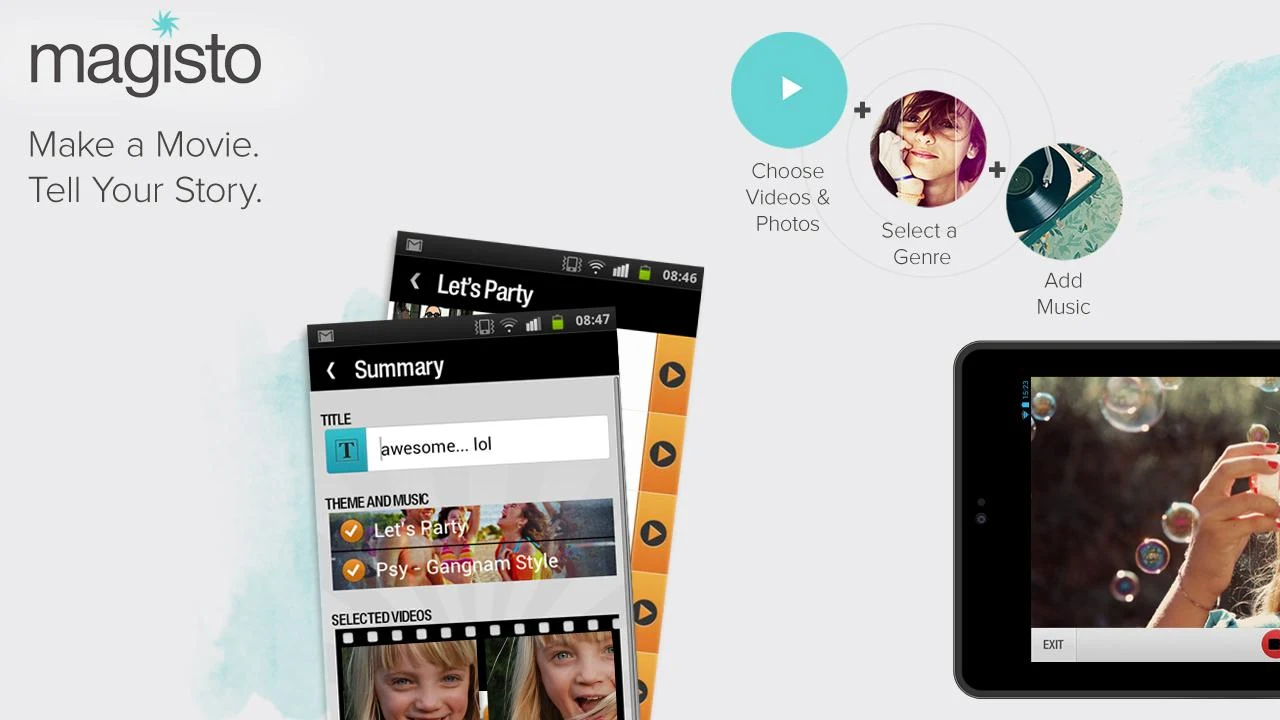
 1. Magisto Video Editor & Maker

  Downloads – 10,000,000+ Stars – 4.4 Price – FREE with option to go premium Magisto Video Editor & Maker is designed to make editing your movies simple. It offers the option for you to pick the videos, photos, music and effects and then it puts it all together to create your very own edited movie. It is the most downloaded video editing app in the Google Play Store, does that make it the best? Not necessarily, but it does offer a large amounts of features: – You can share your videos on all of the social media websites, plus create your own online albums to share publicly or just to your friends and family – It offers, facial recognition, image stabilization, filters, transition, effects – You can use their inbuilt app camera or use videos, photos and music already on your phone or tablet. This app really has got a lot of areas covered. If anything this app specializes in putting all of the transactions and effects together, to make making an edited video easy. Plus all of these features are free. However the free version does limit you to a few things, as the premier version offers longer video uploads, more photos, longer movies, and unlimited downloads. This comes at a cost though of $4.99 a month or $17.99 for the year. For those who would like a simple app to do all of the hard work for them, yet create some very visually effective videos, this is the app to do it.
2. VivaVideo: Free Video Editor
Downloads – 100,000+ Stars – 4.1 Price – FREE VivaVideo promises to make you your very own Hollywood movies! It’s a fun app which boasts some great features: –  Live visual effects mode, so you can record with instant effects, rather than adding them afterwards. – It boasts being number one in various areas; multi capture modes, multi trimmer, multi music, multi titles and having the most, themes effects titles and transitions for free! VivaVideo offers loads of great free features, probably the most you will find on any app. Not only that but the features it does have are really good, offering countless ways to edit your videos, or even your photos into videos. Its simple to use and you can share all your videos on social media websites easily. The app is regularly updated and because it offers so much for free, its hard to not download this app just to play around with it.


3. VidTrim – Video Trimmer
Downloads – 5,000,000+ Stars –  4.4 Price – Free but premium version available VidTrim is a video organizer and editor including quite a few feature including: – A video trimmer, ability to convert video files to MP3 audio. – Multiple ways to share your videos, add music to them and add various cool effects. – The ability to convert the video to MP4, resizing and compressing the video to take up less memory. This app certainly does not win the award for the most features, it does however have a couple of handy features that not all of them do. These include the ability to turn your video into  an audio recording and also convert the video to MP4, plus reduce how much memory the video takes up. Although very simple to operate, it feels a little more of a professionals app, with those additional features that the other apps do not have, plus the massive lack of effects to clog it up. The premium version offers you the most interesting features (adding music, resizing and effects) but at only $3.99 for an ad free app which ultimately does everything you need, it’s a very reasonable price and you can trial it before you make any commitments. If you don’t want an app to do all the work for you, but you want to create a video which is created well without countless effects, then VidTrim is for you.
Recommendations:
If you are looking for an app that can do it all for you, edit, add effects, and music then Magisto Video Editor & Maker  is the one for you.
If you wish to mess around, recording live effects straight onto a video, or spend ages editing the video with loads of free effects, then VivaVideo would tick all the boxes.
If however you prefer a more simple app, but includes some quite techy feature as well as some other options to make a quality looking video then look no further than VidTrim.
These are the top 3 video editing apps which can best suit different people’s needs on their smartphones and tablets. Gone are those nasty VHS recording days! You got to love the high quality Android camera phones and tablets with their powerful editing software! Any questions? Suggestions? Or thoughts? Then please leave us your comments below!

BEST 12 SOCIAL MEDIA MARKETING TIPS TO MASTER

Are you using social media marketing to help grow your business?

Do you have any social media marketing tips that you've learned from your experiences of engaging with people in online networks?


I've found that there are some social media marketing tips that I keep reaffirming and that can help businesses maximise their use of social media as a marketing channel.

Check out these 12 social media marketing tips below. If you're not using any now, then consider doing so...
12 Social Media Marketing Tips

Have A Plan

Don't just post randomly in social media. Don't 'log on' whenever you find time and see what's happening in your streams or who's mentioning a popular hashtag.

That isn't how you should use social media for marketing. That's how you use social for personal use.

In business, you have to be clever. You have to be focused. And you have to be results driven.

A social media marketing plan will allow you to map out where you want to get to, how to get there and how to measure your efforts.

Image source: cdnseed.org

Deliver Value, Consistently

By delivering value, all the time, you position yourself as an authority in your industry or niche. People listen to what you say because they value your words.

This is especially valuable to businesses who utilise social media to attract, retain, convert and even deliver to customers.

Analyse Past Efforts To Improve Performance Going Forwards

If you don't understand what performance your past activities produced, then you will have no solid basis to make improvements.

It's important to learn what worked and what didn't. Failing isn't a bad thing, as long as you learn from it and make the necessary changes going forwards.

Vary Content Formats

If all your social media posts are the same format, your stream can quickly become stale.

Regularly share videos, images, infographics, text posts, vines, slideshares, presentations, podcasts, or any other format you can think of to keep things fresh and engaging.

Host Webinars

Webinars are quite a recent addition to a marketers toolbox. But they work fantastic if promoted and delivered correctly.

They allow you to get face-to-face in the virtual sense, while be able to deliver content, training or services in a one-to-many business model.

Image source: http://blog.visiolink.com/

Use Hashtags Strategically

If you add #hashtags for the sake of it then it creates little value and can actually have a negative effect on the effectiveness of the post.

An example is repeating hashtags. A tweet such as: "Learn how to use #SocialMedia like a pro #SocialMedia" doesn't add any additional exposure.

Among many Twitter social media marketing tips articles is the advice to capitalise hashtags appropriately and not to use more than 2-3 in each tweet.

Add Text To Images For Context

Adding text to images can not only give context, but can provide additional call to actions that are more clearly presented.

It's common for images in articles to include text to explain to the reader a particular viewpoint or provide further direction.

Automate Curated Content

Content curation is the practice of sharing other people's content in your social media streams. It's wise to do so because simply sharing your own links and content will start to put your audiences off.

You can also establish new relationships with content publishers by sharing their related content in your streams, or build reciprocal power for mutual social sharing.

Don't Spread Yourself Too Thin

Trying to be on every platform isn't productive or strategic. Choose which platforms have the highest concentration of your ideal customers and focus on these networks first.

It's more important to ensure your social media marketing efforts are effective, than seeing how many networks you can be apart of.


But Don't Narrow Your Focus Too Much

Becoming too narrow is risky. You don't have the diversity to hedge against setbacks in one network and your business can suffer as a result.

Don't 'Set And Forget' About Your Website Content

Website content, as well as your website design, should be routinely updated. You can't simply write it once then leave it for years to gather dust.

Things change in business. People come and go and your business develops. Keep your website fresh and up to date whenever your business takes steps forwards.

Reengage website visitors with Social Advertising

One advertising method is called reengagement - showing ads to people who have visited your website already.

This has proved to be one of the most effective social media marketing tips when using paid methods because those that see your advert are already familiar with your brand.

They have already been exposed to your business so your marketing messages are being reinforced with trust and acceptance.
Have Your Own Social Media Marketing Tips To Add?

It would be great to hear your social media marketing tips and how they have helped you grow your business. Share your tips in the comments below.